July 1, 2026
Ashley Wilson
Officer, International Fisheries

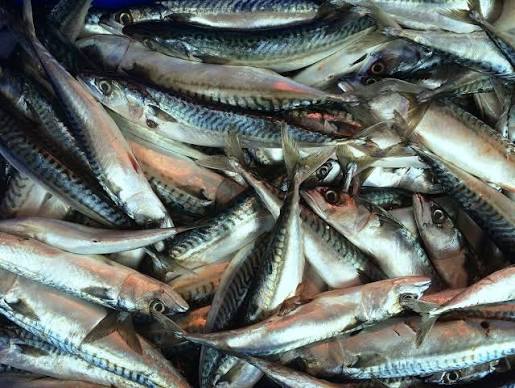
Photo by Vincent van Zeijst. CC BY-SA 3.0.
For more than a decade, fisheries managers in Norway, the European Union, the United Kingdom, the Faroe Islands, Iceland, Greenland and Russia have driven the population of northeast Atlantic mackerel to a historic low. These coastal States, which co-manage the high seas mackerel fishery and are also Parties of the North-East Atlantic Fisheries Commission, have spent years wrangling over quota shares. And despite long-standing commitments to sustainable management, their combined catch is regularly soaring well in excess of the level that science calls for. The subsequent – and predictable – decline in stock size is a dire warning for the future of the fishery. Now these governments are taking renewed steps to develop a long-term management strategy (LTMS) that would recover the species and put it on a more sustainable trajectory. If well implemented, the strategy could help to reverse years of political gridlock over mackerel quotas.
Mismanagement has driven mackerel to an all-time low
As one of the northeast Atlantic’s key pelagic species, mackerel plays an important ecological role within the wider marine system, including as a prey for tuna and other commercial fish species and for marine mammals and seabirds. But since 2017, mackerel have been on a downward path, and little to no action is being taken to change course.
In 2015, 2017 and 2020, the coastal States asked the International Council for the Exploration of the Sea (ICES), the organization that provides scientific advice on fisheries management in the northeast Atlantic, to evaluate a new LTMS for the stock. But over the years, the mackerel fishing nations’ prevailing political priority has been to maximize national catch. And rather than focusing on the long-term health of the fishery, they allowed an existing scientifically evaluated LTMS to expire and failed to adopt a new precautionary one.
Some years, most parties agree to a total catch that’s in line with scientific advice but then go home and take unilateral catches that overshoot the agreed total, leading to overfishing. Through these actions, the coastal States consistently fail to consider the long-term health of the stock and fishery.
This inability to manage the mackerel stock in a precautionary way and with a long-term vision has led to the suspension of ecolabel certifications, an overfished stock and market actors suspending where they source their mackerel.
Figure 1: Boom and Bust of Atlantic Mackerel Driven by Poor Management Decisions
Excessive catches above scientific advice since 2008 and a lapsed long-term management strategy in the context of a changing environment and stock productivity (recruitment) has led to decline
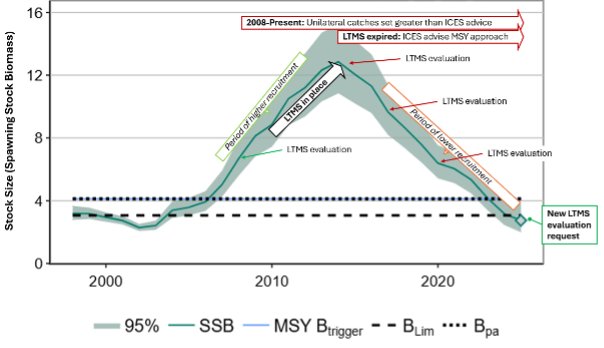
Source: Adapted from ICES (2025) by adding contextual labels to a time-series plot of stock size (spawning stock biomass)
A new science-based management strategy evaluation could provide a path to recovery
The current state of mackerel can be reversed. Managers are realizing that a changing ocean means that stronger, smarter rules are required to recover the stock and ensure a more resilient fishery.
Specifically, climate-driven shifts in stock productivity and distribution, growing ecosystem pressures and competition over access are changing the context in which this fishery is managed. And managers need to consider the damage that mismanagement does not just to the mackerel population but to the broader region’s ecosystem as well.
Fortunately, we know what works: an LTMS (also known as a harvest strategy or management procedure) underpinned by a comprehensive management strategy evaluation (MSE).
An MSE is a critical part of a science-based decision-making framework. It involves stakeholder engagement and accounts for risks and trade-offs among competing objectives, such as maximizing catch and protecting stocks. Through computer simulations, an MSE can be used to assess the performance of a proposed LTMS under a range of environmental conditions and can include ecosystem considerations, such as how many fish should stay in the ocean to meet the needs of predators and other species. An MSE also allows managers to see how a fishery grows or declines in the face of a range of scenarios, therefore making it easier to choose the right LTMS, depending on their goals. For example, managers can ask if the management strategy is resilient to a period where fewer young fish are entering the fishery – and what that means for stock size or catches. They can also ask if the LTMS is robust to specific levels of excess catches and the continued failure to agree allocation.
Despite years of inaction, change may be coming. In early 2026, northeast Atlantic managers submitted a fourth advice request to ICES, asking for new information on a mackerel LTMS using MSE.
There is debate over the scope of the proposed MSE. A basic, single-stock MSE focused narrowly on stock status, yield and catch stability may represent progress compared with current management. But northeast Atlantic mackerel face challenges that go beyond what traditional management techniques can handle. As such, any MSE must respond to the shortfalls in implementation, such as excess catches, and should manage fisheries sustainably and with an ecosystem approach.
A new MSE should evaluate an LTMS that can:
Adopting an MSE-tested LTMS is the goal for 2026-27. Managers have made various global commitments to use marine resources sustainably and to protect biodiversity, and by making a change in mackerel management in the northeast Atlantic, they can show that they are serious about the ecosystem approach and moving towards science-based, sustainable fisheries management.
Ashley Wilson works on The Pew Charitable Trusts’ international fisheries project.

‼️ Join us next month on November 4 (at 11:00 GMT) for the next webinar in our quarterly series! Our expert panel will be discussing how to make management procedures more efficient during both the development and implementation stages.
Register: https://us06web.zoom.us/meeting/register/X7ub2wxiR2-eFKqk8Taqvg#/registration
October 5, 2026

September 22, 2026

September 9, 2026