September 9, 2026
Shana Miller
Project Director, International Fisheries Conservation

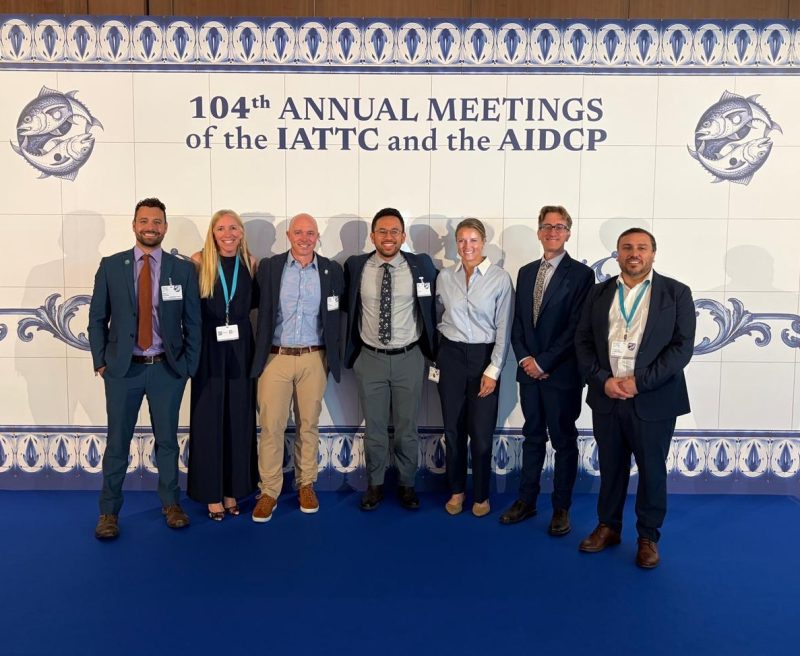
The Inter-American Tropical Tuna Commission (IATTC) held its annual meeting in the historic city of Lisbon, Portugal last week and took the opportunity to make its own mark on history. With adoption of a management procedure (MP) for Pacific bluefin tuna, as well as a measure to implement the MP-based catch limits starting in 2027, IATTC finally joins the other tuna management bodies in application of the MP approach to modernize and improve its management.
However, getting to this point was far from certain.
A hard-won agreement
Despite tentative agreement on the bluefin MP back in March, adoption last week was not assured. Due to a breakdown in negotiations among eastern and western Pacific managers back in July, it looked increasingly unlikely that the MP would make it across the finish line this year. While the MP terms were generally accepted, consensus was held up due to disagreements about how to allocate the MP-based catch limits among countries.
However, demonstrating a rare level of determination and willingness to compromise, with impressive leadership from Japan, the major fishing nations met informally and formally over the past month to work out their differences and come to an agreement. This effort enabled MP adoption in Lisbon and shows what is possible when governments want to make progress.
Because Pacific bluefin tuna is a pan-Pacific stock, the baton now passes to the Western and Central Pacific Fisheries Commission (WCPFC) to adopt a complementary measure when they meet in Vanuatu later in the year.
A step forward for South Pacific swordfish management
Thanks to leadership from Ecuador, the EU, and the U.S., IATTC also agreed to its first-ever measure for South Pacific swordfish. The measure sets provisional reference points for the stock and calls for harvest control rule (HCR) development using management strategy evaluation (MSE). It will be important to work with IATTC scientists to ensure this initiative has the necessary structure and resources to progress over the next couple of years.
A step backward for mahi management
Unfortunately, not all of the week’s decisions moved IATTC toward more robust, MSE-based management.
A revision to the 2023 measure for mahi (dorado) not only failed to add mention of MSE as a potential scientific tool but also removed reference to HCR development, a perplexing and misguided decision for this valuable fishery. Management of the eastern Pacific mahi fishery is challenged by multiple uncertainties, from stock structure questions to reporting deficiencies in the extensive artisanal fisheries. MSE is well-suited to help address these kinds of uncertainties and identify viable management options despite them.
A missed opportunity for tropical tunas
And in the biggest disappointment of the week, IATTC failed to adopt an interim multi-stock tropical tunas MP, despite similar proposals tabled by Ecuador, the U.S., and EU.
The proposed MP was based on seven years of MSE development, which included dialogue with fisheries managers and stakeholders throughout the process on the MP objectives and structure. There were five intersessional dialogue meetings in the past year alone! The proposed MP would have even increased fishing opportunities by decreasing the duration of the purse seine closure. However, as with Pacific bluefin tuna in July, an allocation-related debate only tangentially related to the MP (in this case, fishing capacity allowances per country) held up the agreement, and the existing tropical tunas measure remains in place.
Dr. Glen Holmes (Pew) and I published a paper on MPs and allocation several years ago, presenting the arguments of agreeing allocation before, after, or alongside an MP, and finding that allocation does not need to be agreed prior to MP adoption. It is frustrating to see that progress on this MP adoption is still being held hostage to allocation debates, especially when MP agreement and the predictability of future allowable catch/effort can help to facilitate allocation discussions, as we asserted in the paper.
Hopefully the two will be able to be separated or resolved in tandem next year, so IATTC can adopt a multi-stock MP for tropical tunas in 2027.
An important milestone, and more work ahead
Overall though, IATTC made measurable improvements to its management last week, with Pacific bluefin as its first implemented MP a cause for celebration. While IATTC adopted an MP for North Pacific albacore in 2023, they have yet to convert the MP output into catch and/or effort limits so it can be applied. Thankfully, that’s on the agenda for 2027, so when combined with the potential for adoption of the multi-stock tropical tunas MP, next year could be a very big year for MSE-based MPs in the eastern Pacific.
The progress in Lisbon also demonstrates the value of sustained intersessional dialogue. Pacific bluefin showed that difficult allocation disputes can be overcome when governments are committed to working toward consensus, while the lack of agreement on tropical tunas showed the consequences when those issues remain unresolved. Intersessional dialogue will be key to building on this year’s progress, so we’re eagerly awaiting the proposed 2026-27 IATTC calendar. We look forward to partnering with IATTC members to get the job done!

‼️ Join us next month on November 4 (at 11:00 GMT) for the next webinar in our quarterly series! Our expert panel will be discussing how to make management procedures more efficient during both the development and implementation stages.
Register: https://us06web.zoom.us/meeting/register/X7ub2wxiR2-eFKqk8Taqvg#/registration

October 5, 2026

September 22, 2026
September 9, 2026