April 28, 2026
Shana Miller
©FAO/Giulio Napolitano
Blog originally published on FAO’s Common Oceans Program Newsroom.
Focus on All Tunas 2028 for the adoption of long-term harvest strategies
28/04/2026
Boston – Tuna harvesting and sustainability generated widespread interest during events staged by the Common Oceans Program Tuna project at the Seafood Expo North America in March.
The Seafood Expo North America (SENA) is the continent’s largest seafood show. This year’s event from 15-17 March drew more than 20,000 industry professionals and experts who exchanged views on the current state and the future of the seafood sector.
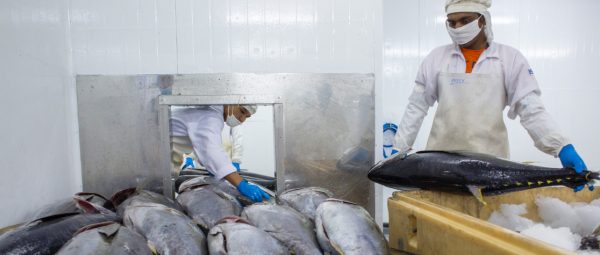
The role of tunas, some of the most important seafood species in overall volume and value, was advanced by the GEF-funded Common Oceans Tuna project through a booth and panel discussion to promote the All Tunas 2028 initiative.
All Tunas 2028 aims to give seafood retailers, wholesalers, distributors, and others a voice to promote adoption of harvest strategies for the most commercially valuable tuna stocks by the end of 2028.
More than 60 people attended the panel discussion which highlighted the importance of management procedures (MPs), also known as harvest strategies, and their impact on the seafood supply chain as well as the vital role played by Regional Fisheries Management Organizations (RFMOs).
Shana Miller, project director, International Fisheries Conservation at The Ocean Foundation, said: “SENA provided a valuable opportunity to engage with an often-underrepresented RFMO stakeholder—the seafood supply chain professionals who bring fish from vessel to consumer.”
“Harvest strategies are essential for ensuring the long-term fishery stability and abundance that underpin their businesses,” Miller said. “That’s why they support All Tunas 2028, and HarvestStrategies.org is proud to be the online home of this important initiative.”
Katy Hladki, senior officer, markets, international fisheries at The Pew Charitable Trusts, stressed the importance of SENA as an opportunity to engage with stakeholders across the supply chain.
“We were excited to see such strong interest in the All Tunas 2028 initiative,” Hladki said. “It was a great kick off to this important work to bring market voices to RFMOs and support the timely adoption of harvest strategies for all tuna stocks.”
RFMOs are critical for the management of the world’s most valuable fisheries, yet the seafood markets and in particular, consumers, rarely participate in their decisions.
Industry taking the next step to connect RFMOs with fisheries and markets
Nicole Condon, the director of Brand & Social Impact at Oddisea SuperFrozen and Vice-Chair of the board at Sea Pact, said industry players, like Sea Pact, were taking the next step in RFMO engagement to connect fisheries and the markets in which we operate.
“We often find a gap between in-market sustainability demands—including new regulatory requirements—and the adoption and implementation of critical steps, such as harvest strategies, at the RFMO level,” Condon said.
“We must do more to not only relay the urgency of this work for our own operations further down the supply chain, but also do more to build trust as reliable partners in this process. That is why we support initiatives like All Tunas 2028.”
Across the five tuna RFMOs, MPs have been adopted for a subset of the world’s commercially important tuna stocks, covering more than half global tuna production. However, progress remains uneven.
Of the 23 RFMO‑managed commercially important tuna stocks, only ten currently have an agreed management procedures in place. Eight others are at advanced stages of MP development, while for four stocks, development has yet to be initiated.
That means a substantial share of global tuna production continues to be managed through stock‑assessment‑based decision‑making, alongside ongoing efforts to broaden the application of management procedures
FAO has developed an e-learning series, Management Procedures for sustainable tuna fisheries in collaboration with The Ocean Foundation, the ISSF and The Pew Charitable Trusts. The series introduces core concepts behind management procedures, or harvest strategies, and step-by-step training that aims to strengthen the capacity of fisheries professionals to actively engage in their development and implementation.
Harvest strategies provide for pre-agreed decision-making frameworks that determine allowable fishing levels under different stock conditions. They aim to keep fisheries within sustainable limits while reducing the risk of stock decline.
To learn more:
https://elearning.fao.org/course/mp-series-en

‼️ Join us next month on November 4 (at 11:00 GMT) for the next webinar in our quarterly series! Our expert panel will be discussing how to make management procedures more efficient during both the development and implementation stages.
Register: https://us06web.zoom.us/meeting/register/X7ub2wxiR2-eFKqk8Taqvg#/registration
October 5, 2026

September 22, 2026
September 9, 2026