August 26, 2021
Shana Miller
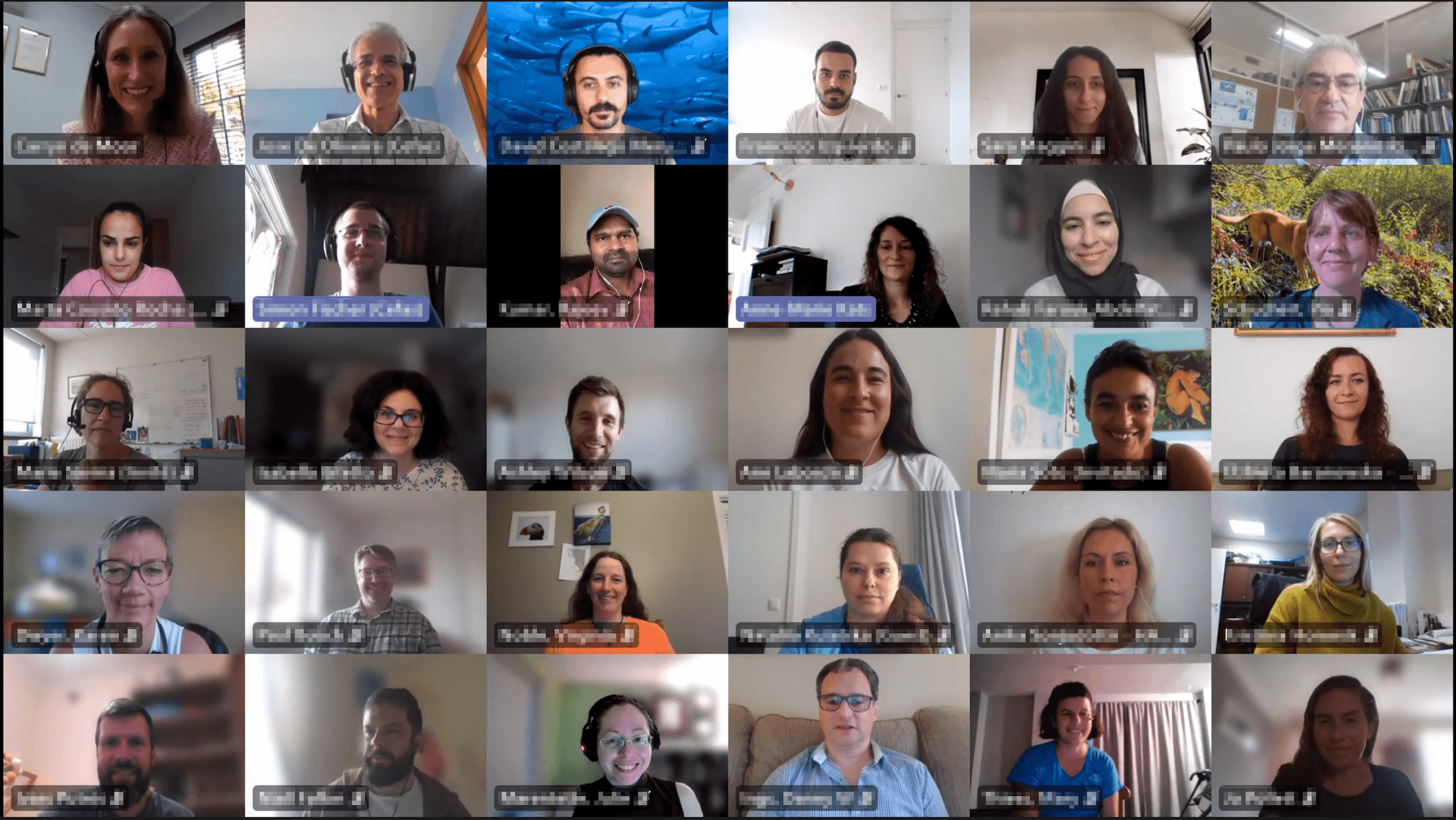
Image details: Introduction to Management Strategy Evaluation Training Course group photo – Credit: ICES, 2021
This week, the International Council for the Exploration of the Sea (ICES) is demonstrating their commitment to harvest strategy capacity building by hosting a training course, titled “Introduction to Management Strategy Evaluation” (MSE). Expert scientists in the field of MSE are instructing the course, notably Drs. José De Oliveira and Simon Fischer of the UK government’s Centre for Environment, Fisheries and Aquaculture Science (CEFAS) and Dr. Carryn de Moor of the University of Cape Town in South Africa.
The course (held 23-27 August 2021) seeks to educate interested scientists and managers about the ins-and-outs of MSE through conceptual lectures on specific elements of MSE and explorations of practical case studies. Topics include an introduction to operating models, management strategies (also known as harvest strategies or management procedures), uncertainty, risk, and communication of results. In addition to these modules, small group discussions are being held to help participants embed learnings and explore practical examples. Participants are using Excel and FLR, a fisheries library of quantitative tools that uses the coding language R, to navigate course exercises.
Management strategy evaluation is a key tool in the harvest strategy development process. Through MSE, scientists can simulate the workings of a fisheries system and test whether potential harvest strategies can achieve pre-agreed management objectives. Simulating the fishery years into the future by incorporating a breadth of operating models into the MSE framework allows scientists to determine which harvest strategy performs best over a range of potential scenarios, providing the information managers need to choose which harvest strategy to adopt. To this end, a critical element of MSE is transforming results into accessible visualizations to ensure that non-experts can interpret the outcomes of the MSE when selecting a final harvest strategy for adoption. Harveststrategies.org has developed a package of graphical tools to help scientists deliver their results clearly and concisely to managers and stakeholders.
Continued education regarding MSE and other aspects of a harvest strategy is a key ingredient to real-world implementation of the approach. Harvest strategies are a particularly effective form of management because their development incorporates input from managers throughout the entire process. Thus, familiarizing managers and other stakeholders with key concepts, as is being done at this week’s ICES workshop, ensures that all decision-makers can play a role in harvest strategy development. This continued dedication by ICES to harvest strategy and MSE instruction is integral to advancing harvest strategies towards adoption in the Northeast Atlantic and across the globe.

‼️ Join us next month on November 4 (at 11:00 GMT) for the next webinar in our quarterly series! Our expert panel will be discussing how to make management procedures more efficient during both the development and implementation stages.
Register: https://us06web.zoom.us/meeting/register/X7ub2wxiR2-eFKqk8Taqvg#/registration

October 5, 2026

September 22, 2026
September 9, 2026