July 9, 2024
Sona Park
Researcher, Citizens' Institute for Environmental Studies 

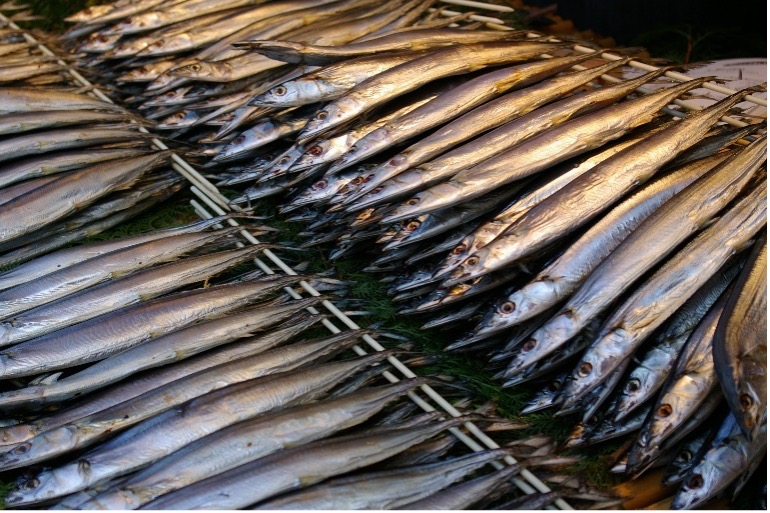
Pacific saury is one of the popular fishes in Korea. The general public enjoys it for its rich nutrition and affordability. People savour saury in various forms, such as grilled, canned, and semi-dried with diverse recipes. For example, canned saury in kimchi stew is a common lunch choice for business workers in Korea. Beloved by many Koreans and people around the world, saury is a keystone species for a healthy marine ecosystem and plays a crucial role as a climate change indicator species. However, Pacific Saury is facing a serious depletion crisis (see Figure 1).
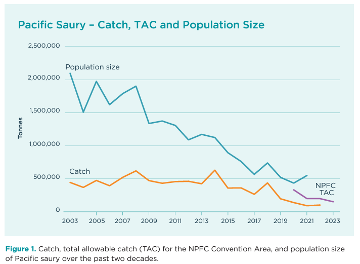
Rising sea temperatures due to climate change seriously threaten saury and can alter its distribution and migration patterns during its peak fishing season from October to November. Climate change has already led to decreased saury harvests in the waters surrounding Korea and the broader North Pacific, which is further exacerbated by excessive fishing activities. With its short lifespan and sensitivity to environmental changes, saury presents challenges in predictable management. Given growing effects from climate change and threats from overfishing, a management procedure is urgently needed to protect saury for the long-term.
Harvest strategy discussions have begun within the North Pacific Fisheries Commission (NPFC), most notably with the recent adoption of a harvest control rule (HCR) for saury. HCRs are the operational component of a harvest strategy, which are essentially pre-agreed guidelines that determine how much fishing can occur based on indicators of the target stock’s status. Therefore, adopting HCRs is essential for recovering declining saury populations and effectively managing unpredictable changes. Some RFMOs have successfully implemented similar management procedures (MPs), including HCRs, for tuna and other species.
At the 2024 Commission meeting, the NPFC adopted an HCR for Pacific saury, which constrains the limits of the maximum change in catch (MAC) to 10% but sets an immediate total allowable catch (TAC) of 135,000 metric tons. Some member states supported an HCR with a MAC of 40%, but others favoured the 10% MAC option and sought to postpone the implementation of the HCR by a year. Ultimately, the compromise reached on the HCR represents an improvement over the current situation and is expected to facilitate rebuilding the saury stock to Bmsy (biomass at maximum sustainable yield) by 2028. Importantly, this compromise marks progress towards developing and implementing a comprehensive MP for Pacific Saury based on a full scientific testing process called management strategy evaluation, which is expected to be adopted by the 2027 Commission meeting.
Given recent climate fluctuations and excessive fishing, the decline in saury populations has intensified, further complicating management efforts. Therefore, proactive, science-based management through its interim HCR and, subsequently, a comprehensive management procedure is crucial. To achieve this, stakeholders in the NPFC, including significant fishing nations and citizens who enjoy seafood, must prioritise conservation efforts and sustainable management practices. We all hope to see increased efforts for the Pacific Saury conservation in the NPFC Convention Area in the near future.

‼️ Join us next month on November 4 (at 11:00 GMT) for the next webinar in our quarterly series! Our expert panel will be discussing how to make management procedures more efficient during both the development and implementation stages.
Register: https://us06web.zoom.us/meeting/register/X7ub2wxiR2-eFKqk8Taqvg#/registration

October 5, 2026

September 22, 2026
September 9, 2026