September 28, 2022
John Bohorquez
Senior Program Associate, International Fisheries 

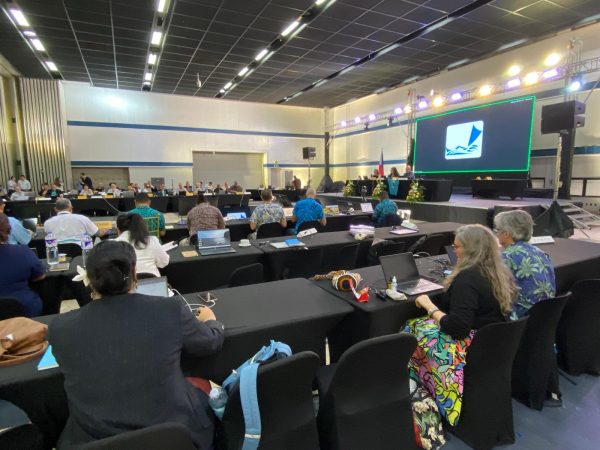
In global politics, it’s easy for the world’s largest economic powers to crowd the room and dominate the discussion. But within the Western and Central Pacific Fisheries Commission (WCPFC), a group of Small Island Developing States has banded together to create one of the most influential alliances in international fisheries. Four NGOs are now appealing to this group in an open letter (below) to once again show leadership in promoting sustainability of the highly valuable tuna fisheries in the region.
The eight Pacific countries that make up the Parties to the Nauru Agreement (PNA) have economic sovereignty over a stretch of ocean that has historically supported 60% of tuna landings in the WCPFC and 25-30% globally. Most of this, about 1.8 million metric tons per year, comes from skipjack tuna. The NGO letter is in response to the PNA’s recent position on future management of skipjack, which was announced at a recent WCPFC meeting. The NGOs, The Pew Charitable Trusts, WWF, the Global Tuna Alliance, and The Ocean Foundation’s International Fisheries Conservation project, have decades of experience working in the WCPFC.
Eight years ago, WCPFC members – including PNA – committed to developing and implementing a harvest strategy for skipjack tuna, among other key stocks. Making this commitment was a great step from PNA to secure a sustainable future for Pacific skipjack. The science and management inputs are now ready for harvest strategy adoption on schedule at WCPFC’s annual meeting next month. Yet, now PNA is proposing to adopt the harvest strategy but delay its implementation by an additional six years, treating it as an experiment that managers can choose whether or not to follow. This is counter to a fundamental tenet of the harvest strategies approach. Once you agree to the rules of the game, you need to stick to them, or the carefully tested and developed approach cannot be expected to be successful.
Delaying the implementation of the harvest strategy stands only to put the skipjack fishery at risk. The western and central Pacific region cannot afford to potentially miss out on this hard-earned opportunity to leverage a wealth of additional knowledge into proactive decision making like never before, and one required to match an increasingly unpredictable world. Please see below or click here to read the full text of the letter.
Open-letter-to-PNA_FINAL
Watch the latest video from @spc_cps “Developing Harvest Strategies for Pacific Tuna Fisheries” series. It breaks down performance indicators through creative examples, making the topic accessible and memorable.
#tuna #sustainability #MPs #fisheries
We attended a @iattc_ciat working group on mahi mahi in the Eastern Pacific Ocean last week! We discussed updating the stock assessment and an accompanying management strategy evaluation, and we're excited to see where this collaboration leads!
#MSE #StockAssessment #Fisheries
April 2, 2026