
Photo by Rod Waddington. CC BY-SA 2.0.
The management procedure (MP) framework — management objectives, reference points, harvest control rules (HCRs), and MPs — is current best practice in fisheries management, replacing traditional reactive management with a proactive approach based on a pre-agreed decision framework.
MPs – also known as harvest strategies – have themselves undergone a significant evolution. It was not that long ago that MPs were less known and even lesser used in fisheries, particularly internationally managed ones. Then, they became the domain of a handful of well-monitored fisheries, slowly becoming mainstream fisheries management. The key to the success of MPs is their ability to simulate future scenarios and test management approach effectiveness, therefore providing confidence in the pre-agreed decision rules.
MPs have also progressively been adapted to more data-limited contexts with empirical MPs, including catch per unit effort (CPUE) and length-based HCRs. Each step has extended the reach of the MP discipline to stocks that would previously have been considered unmanageable under this kind of framework.
The next frontier is the stocks that are beyond even those adapted methods: fisheries where a reliable CPUE series is not available, and where conventional data-limited approaches are quantitatively impossible (i.e. it is not possible to build a simulation system to test potential management decisions).
The standard response in these cases in international fisheries is to apply precautionary catch limits derived from historical averages and move on – or set no limits at all and hope for the best. Aspects of that approach are defensible as an interim measure. As a permanent management approach, though, it forgoes many of the benefits an MP framework is designed to provide.
The question is then: How can the benefits of an MP be realised when it is not possible to construct and quantitatively test an MP? How can we take those MP principles and apply them to a greater number of fisheries?
The Southern Indian Ocean Fisheries Agreement (SIOFA) is exploring that very question in an internationally novel way.
SIOFA is an organisation with a significant management challenge. It is responsible for more than 100+ species under its mandate, many of which are smaller fisheries or are severely data challenged. For SIOFA, a substantial proportion of stocks fall into this category — stocks for which the quantitative toolkit, even in its most adapted data-limited forms, simply does not work.
SIOFA’s new Precautionary Approach and Management (PAM) Framework, under development through its Scientific Committee and funded by the EU, seeks to address this directly. It is attuned to the fact that it has this full diversity of stocks of varying commercial importance, and with different levels of data quality. Some stocks will justify significant ongoing scientific investment. Others are lower priority — but that does not mean SIOFA can afford to ignore them. A stock that slips into serious decline through inattention is a management failure regardless of its commercial value.
The PAM Framework’s response is not to draw a line below which proactive management does not apply, but instead to design a tiered system that extends MP discipline as far as the data will allow, for every stock under its remit — including for stocks where quantitative methods are not currently feasible. The PAM Framework creates “Tier 1” and “Tier 2” MPs (both quantitative, with different levels of sophistication of testing using management strategy evaluation, or MSE) — the typical MPs we see in fisheries management. And then it goes one step further to extend MP principles to even the most data-limited of fisheries. Its “Tier 3 Qualitative MP” is the instrument for that extension.
Many of the most durable benefits of an MP are structural, not computational. Pre-agreed rules shift management decisions from reactive, case-by-case negotiation to a rules-based system agreed in advance. Explicit consideration of future scenarios, including adverse ones, disciplines decision-making in ways that traditional assessment advice rarely does. Defined monitoring triggers create accountability and an evidence base for future review.
A Qualitative MP formalises these benefits. It is a full MP in its composition: it requires a fishery definition, explicit management objectives, limit reference points, HCRs, performance monitoring, exceptional circumstances protocols, and scheduled review — the same core architecture as a quantitative or empirically-derived MP.
What differs is how elements are developed, selected, and implemented. Most notably, Qualitative MPs are not developed using quantitative simulation testing, a fundamental element of what typically makes an MP an MP. For these Tier 3 stocks, quantitative analyses are impossible. Stock assessment relies on the best available method given the data — which at this tier means qualitative analysis: expert judgement applied to life history knowledge from analogous species; observable indicators such as changes in catch composition, fish size, or fleet behaviour; and any other evidence the fishery or other sources can provide. And similarly, when it comes to MP development, in place of quantitative MSE modelling, structured qualitative evaluation applies: an independent expert panel (odd-numbered to allow majority decision-making) is asked the same question the quantitative simulation would perform. It considers the plausible scenarios for the stock (changes in fishing dynamics, recruitment variability, environmental shifts, alternative biological assumptions), evaluates candidate management approaches against the agreed management objectives, and recommends the approach most likely to meet those objectives. Where panel members disagree, the range of opinions and the driving factors are documented. The HCRs that result may be qualitative — a defined catch trigger, escalating levels of intervention, or thresholds based on observable changes — but they are pre-agreed, explicit, and binding in the same way as any other HCR.
The output is a complete MP. It is evaluated differently, and its rules may be expressed qualitatively rather than quantitatively, but it carries the same procedural weight and the same expectation of compliance as any other MP adopted under the PAM Framework.
Expert knowledge should not be considered a substitute where sufficient fisheries data exists — but it is data that can be used where it doesn’t. Scientists, managers, and industry participants carry substantial knowledge that never enters a formal assessment process: life history understanding from analogous species, observations of shifts in catch composition or fleet behaviour, and practical understanding of what the monitoring system can and cannot detect. Structured evaluation makes that knowledge explicit, subjects it to independent scrutiny, and converts it into documented, auditable management advice.
Qualitative MPs should be treated as temporary. The process of structured expert evaluation is good at identifying, with some precision, exactly which data gaps are preventing graduation to a higher (quantitative) tier. That specificity creates an institutional case for closing data gaps, which does not exist when a stock sits entirely outside the management framework. The PAM Framework builds in scheduled re-evaluation and expects stocks to graduate upward as understanding improves, but it also acknowledges that graduation requires a genuine commitment to monitoring and data collection.
Qualitative MPs are not the goal. An MP should always be as quantitative as the data will support. Qualitative MPs are the floor, not the default — the point is to match the rigour of the MP to the information available, and to push that rigour as far as possible.
A Qualitative MP will never deliver the confidence that a quantitatively developed MP will provide. But, for stocks that currently have no structured management framework at all, the question is not whether the MP is perfect — it is whether it is better than the alternative. Structured objectives, pre-agreed rules, independent evaluation, explicit precaution, and a defined pathway toward more rigorous management is a meaningful foundation.
Fisheries professionals have spent decades demonstrating that proactive, rules-based management outperforms reactive decision-making. Tier 3 Qualitative MPs extend that argument to the fisheries that have, until now, been left out of it.
Kerrie Robertson previously chaired the Southern Indian Ocean Fisheries Agreement (SIOFA) and two subsidiary committees of the South Pacific Regional Fisheries Management Organisation (SPRFMO). She represented governments in multilateral negotiations spanning UN frameworks and many RFMOs. Her consultancy work through Adira Consulting focuses on translating complex legal instruments into workable governance arrangements, particularly for Pacific Island nations. She has spent her career working at the intersection of international law, fisheries science, and cross-cultural collaboration—convinced that effective ocean governance comes from dialogue, commitment to progress and ensuring that all voices are genuinely heard at the table.
Earlier this month, Ash Wilson (The Pew Charitable Trusts) and I co-convened a workshop titled ‘Operationalizing Ecosystem-Based Management of Forage Species using Management Strategy Evaluation.’ The workshop was part of the program at the Small Pelagic Fish International Symposium hosted by ICES, PICES, and FAO in La Paz, Mexico. Held on May 4, 2026, the half-day workshop brought together 25 participants working in management strategy evaluation (MSE), ecosystem-based fisheries management (EBFM), and the intersection between the two. Through expert presentations and breakout discussions, workshop attendees explored how MSE-tested management procedures, also known as harvest strategies, can help advance ecosystem-based management approaches for forage fisheries under increasing environmental uncertainty.
Why MSE for forage species?
Forage species (e.g., sardine, anchovy, herring) play a critical role in the marine food web, linking low and high trophic levels by providing a key prey resource for predators such as marine mammals, seabirds, and large commercially important fishes (e.g., tunas, billfishes). However, their abundance in space and time is highly dependent on changing environmental conditions. Effective management of these species therefore poses a challenge, as patterns in their recruitment and biomass are driven by multiple interacting ecosystem and environmental factors, the individual impacts of which can be difficult to tease apart and simulate. Additionally, perceived relationships between the environment and forage fish population dynamics often break down over time, leading to high uncertainty in estimating recruitment and natural mortality using traditional stock assessment methods.
MSE is an ideal tool for addressing these management challenges for forage species, as MSE frameworks can be built to capture a wide range of possible ecosystem conditions and uncertainties, allowing managers to identify management procedures that remain robust under changing environmental and ecosystem conditions.
Showcasing emerging tools and real-world applications
In six presentations delivered by experts in the field, the workshop showcased existing research initiatives, case studies, and emerging tools designed to incorporate ecosystem considerations into fisheries management through MSE.
Three case study presentations highlighted regional examples of ecosystem considerations in MSE.
Regional discussions reveal shared challenges
Following the presentations, participants broke into regional discussion groups, where they discussed region- and stock-specific considerations for operationalizing EBFM, including identifying key drivers of variability, potential ecosystem indicators, critical data needs (including for building MSE frameworks), and the remaining hurdles to bridge science and management. Example fisheries discussed included Pacific sardine in the California Current, Gulf of Mexico menhaden, Bay of Biscay anchovy, Iberian sardine, and North Sea and Central Baltic herring. Across stocks, workshop participants repeatedly identified the need for a better mechanistic understanding of links between environmental variability and fish population dynamics in order to successfully incorporate ecosystem considerations into management. Similar ecosystem drivers, including upwelling and predation mortality, were identified across systems. At the same time, possible or existing approaches for incorporating ecosystem information into management (including MSE frameworks) varied among regions and species, reflecting differences in available data, ecosystem dynamics, and institutional contexts.
Looking ahead
A summary of the workshop, including a synthesis of breakout group findings on common challenges, shared ecosystem drivers, feasible indicators for MSE frameworks, and opportunities for collaboration across regions and forage stocks, will be published in the July 2026 edition of PICES Press. Additionally, key takeaways from presentations and discussions will be incorporated into a joint paper with other Symposium convenors and attendees, to be submitted to a special issue of a peer-reviewed journal.
Overall, the workshop highlighted the growing momentum and available tools for using MSE to operationalize ecosystem-based fisheries management for forage species and other stocks. As climate change and increasing environmental variability continue to impact ecosystems and fishery dynamics, implementing ecosystem-informed management approaches including MSE will become even more important for supporting sustainable fisheries.
Photo by Willy Goldsmith | Flickr. CC BY-ND 2.0.
2026 marks the 60th anniversary of the International Commission for the Conservation of Atlantic Tunas (ICCAT). Now with 55 contracting parties, ICCAT is divided into 4 panels responsible for managing tunas, swordfish, sharks, and other species across the entire Atlantic Ocean. Each panel has a chair who is formally elected by the Commission to lead discussions on management of their respective stocks. In celebration of ICCAT’s 60th anniversary, this article highlights reflections from all current panel chairs, focusing on major achievements and the trajectory of management strategy evaluation (MSE) and management procedures (MPs).
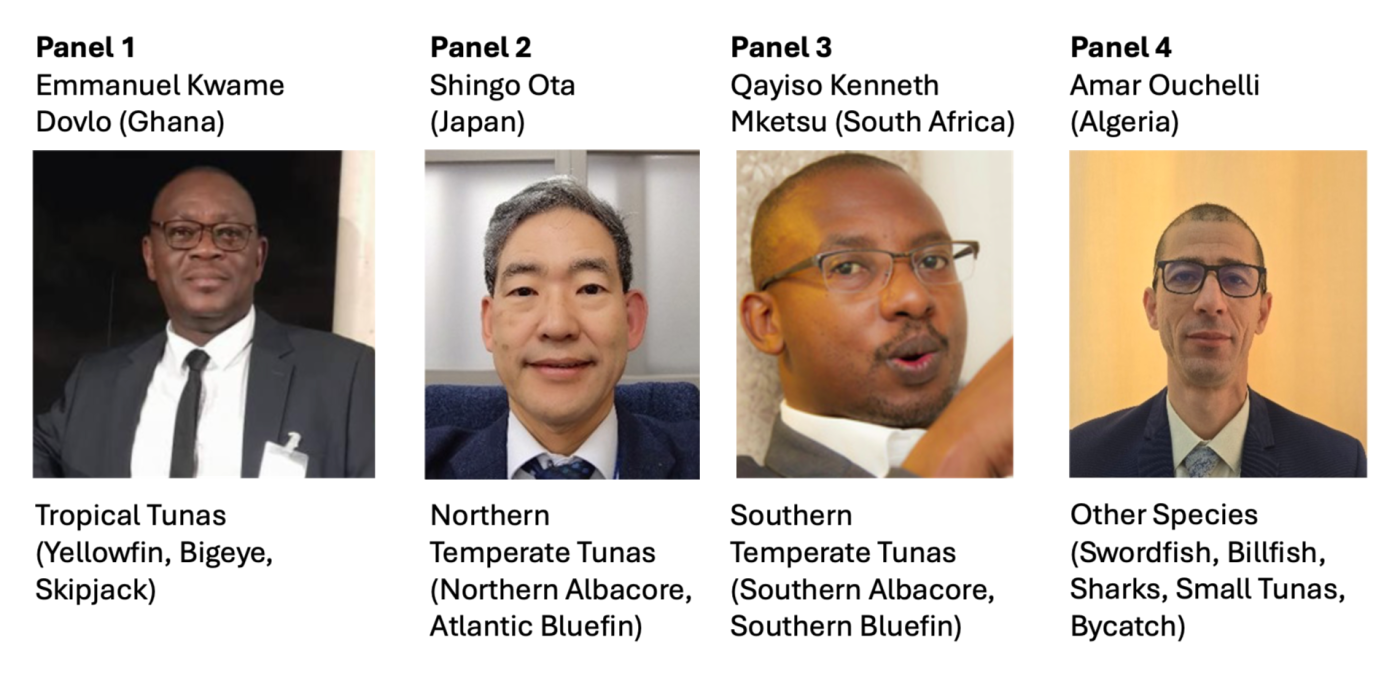
Dovlo – In 2023, I inherited chairmanship of Panel 1 amidst challenging negotiations on the multi-annual conservation and management programme for tropical tunas. I worked with almost all ICCAT members to conclude 5 years of intense discussions for a new measure to finally be adopted in 2024. An agreement was reached for a new total allowable catch (TAC) of 73,011 t for bigeye tuna, with a new catch limit allocation table that reserved 6,100 t for the small harvesters, while the TAC for yellowfin tuna remains at 110,000 t. This process demonstrated high-level collaboration to converge science-based management and balance individual member interests. In the same year, two important milestones in the development of tropical tunas MSEs were recorded – interim operational management objectives for Atlantic bigeye tuna, yellowfin tuna, and the eastern stock of skipjack tuna, and candidate MPs (CMPs) for Western Atlantic skipjack tuna. In 2025, the first ever tropical tunas MSE was adopted – Recommendation by ICCAT on a management procedure for Western Atlantic skipjack tuna.
Ota – I have been the Panel 2 Chair since 2017. There is no doubt that the most successful event during my tenure is the establishment of an MP for Atlantic bluefin tuna in 2022. For a long time, this species had been managed on a stock basis, namely the eastern stock and the western stock. The Commission set a TAC for the eastern stock at a level higher than the scientific recommendation of the Standing Committee on Research and Statistics (SCRS) before 2010. Even after that, the Commission spent much time deciding on the TAC for both stocks because the scientific recommendation was not clear due to data deficiency. To overcome scientific uncertainties and avoid political intervention, the Commission decided to establish an MP since it automatically calculates TAC levels, giving due consideration to scientific uncertainties. It was not easy for managers and stakeholders, particularly fishermen, to understand what was going on in the MSE that produced the MP. Managers and stakeholders tend to look at the possible immediate TAC level while scientists want to look at the performance of an MP for the longer term. Nonetheless, scientists, managers, and stakeholders worked very hard and were able to narrow down the number of candidate MPs from nine to two but could not pick one of them. Finally, on the evening before the last day of the 2022 annual meeting, the Commission agreed to one of them, which would be used to set the TAC for 3-year management cycles. That same day, the Commission also adopted an annual TAC for the first management cycle based on the adopted MP (i.e., 2023-25). The Commission also agreed to allocations among Members.
Mketsu – During my tenure as Chair of Panel 3, one of the key successes has been maintaining a stable and well-managed stock for South Atlantic albacore. The stock has consistently remained in the green quadrant of the Kobe plot, indicating that it is not overfished and that overfishing is not occurring, reflecting sustained collective management efforts by Contracting Parties and Cooperating non-Contracting Parties, Entities, and Fishing Entities (CPCs). In addition, an important recent milestone was the agreement in 2024 on initial operational management objectives for this stock, alongside a structured roadmap toward the development and adoption of an MP in 2027. This represents a significant step in transitioning from traditional management approaches toward more forward-looking, MSE-based frameworks.
Ouchelli – Over the past three years, in my capacity as Chair of Panel 4, we have worked collectively to strengthen conservation measures applicable to several species. The Commission has accordingly approved the measures proposed by Panel 4 prohibiting the retention of the whale shark, mobulid rays (Mobulidae), the basking shark, and the great white shark. Membership of Panel 4 has expanded to now include 44 Contracting Parties, and among the notable achievements is the 2024 MP adoption for North Atlantic swordfish, which established the TAC for the years 2025–2027. This follows extensive work by the scientific working group, as well as close collaboration among all Contracting Parties and stakeholders.
Dovlo – The first ever tropical tuna multi-stock MSE – which aims to evaluate robust MPs within a mixed-fishery context – was initially slated for completion and MP adoption this year. However, at the 2026 Intersessional Meeting of the Tropical Tunas Species Group (20-22 April), the group recommended updating Operating Models (OMs) to the 2025 Atlantic bigeye tuna stock assessment to reflect recent fishery trends and revised assumptions about natural mortality and uncertainty. A 2027 MP adoption has since been proposed to modify OMs and test CMPs in single-stock MSEs before progressing to multi-stock MSEs. That said, there is still work for the panel to do this year on this MSE as it will be important for Panel 1 to review and provide feedback on the initial CMP structure and results at the next meeting in November. With last year’s adoption of the MP for Western Atlantic skipjack tuna, work has also started on the stock’s exceptional circumstances protocol.
Ota – During the 2025 SCRS meeting, scientists could not agree on how to handle data from an Atlantic bluefin genetic analysis known as close-kin mark recapture (CKMR), which indicated that the western stock was much larger than previously considered. More specifically, scientists could not agree on whether the availability of such new data and the calculated size of the western stock would justify an exceptional circumstance (i.e., an unforeseen event or condition that falls outside the range of possibilities tested in the MSE). As a result, the SCRS provided two sets of TACs to the Commission. Further, some Members advocated that their fishermen were seeing a large number of fish in recent years, which corresponded to the results of the CKMR analysis. The Commission agreed to a TAC for the west area that is not necessarily in line with the MP but confirmed that the MP will be applied strictly at the 2028 annual meeting. In the meantime, work has begun on the bluefin tuna MSE health check and MP review, per the schedule agreed in the adopted MP.
Mketsu – The current focus is on advancing the technical development of the MSE for South Atlantic albacore. This includes further refinement of OMs, continued testing of CMPs, and incorporation of key sources of uncertainty identified by the SCRS. A dedicated MSE Technical Team has been established, and initial work has already been undertaken, including conditioning OMs on the 2020 stock assessment and exploring uncertainty through multiple scenarios. Upcoming work includes data preparation, refinement of CMPs, and continued interaction between the SCRS and Panel 3 to ensure that performance indicators align with agreed objectives. I look forward to reviewing the initial MSE results within Panel 3 at the 2026 Commission meeting.
Ouchelli – This year, per the MP adopted for North Atlantic swordfish, Panel 4 will assess exceptional circumstances. It should be emphasized that the adoption of this MP has paved the way for the MSE approach for blue shark (Prionace glauca), which is currently ongoing. Furthermore, stock assessments for Mediterranean and South Atlantic swordfish are being conducted this year, which may serve as a basis for future MSE-related work.
Dovlo – With the support of all Panel 1 members, I expect to see some preliminary results for the tropical tunas multi-stock MSE CMPs this year, along with a thorough roadmap for feedback and fine tuning for adoption in 2027. Also noteworthy is the exceptional circumstances protocol for Western Atlantic skipjack tuna incorporating climate change scenarios for adoption in 2026.
Ota – Based on the work plan for bluefin tuna agreed to in 2022, the Commission will start checking the stock status in 2026 and reviewing the current MP in 2027, which may end up with amendments to the MP or establishment of a new MP in 2028. For this purpose, several intersessional meetings involving scientists, managers, and stakeholders may be needed again in 2026 and 2027. This is also different from the initial expectation that once an MP is established, not so much time and energy will be required to maintain it. People are beginning to understand that an MSE and maintenance of an MP can sometimes be cumbersome rather than saving time, but there is no option to go back to the old era when Members had different interpretations on scientific advice and spent so much time agreeing to TACs. Brushing up on the MP would be the only way forward.
Mketsu – Given the significant progress made to date, there is a growing sense that this South Atlantic albacore work may advance more rapidly than initially anticipated. Subject to continued technical and policy alignment, it would not be unreasonable to envisage the Panel being in a position to consider adoption of an MP earlier than planned, potentially as early as the coming year. The agreed roadmap provides a clear pathway toward adoption of an MP, currently envisaged by 2027. In the near term, efforts will focus on finalizing the MSE framework, refining CMPs, and evaluating their performance against agreed objectives.
Over the medium term, the process will move toward narrowing down CMPs and supporting decision-making within Panel 3, with the aim of adopting an MP at the Commission level. Beyond this, attention will shift to implementation aspects, including the development of protocols for exceptional circumstances and ongoing evaluation of performance.
Overall, if momentum is maintained, this process has the potential to further strengthen the long-term stability and predictability of management for South Atlantic albacore within ICCAT.
Ouchelli – I expect to see gradual expansion of current management measures to other shark species and the integration of climate change impacts into our overall approach. There has been particular interest in climate change testing for MPs developed through MSE. Members are working diligently to strengthen data collection of sharks and other bycatch species which will help inform the Panel 4 recommendations to the Commission.
Plans are in the works for a more defined, thorough consultative process that promotes inclusive fisheries management. This may be especially relevant within the framework of establishing recovery programs for white marlin and roundscale spearfish. This approach takes into account the specific circumstances of CPCs that are Small Island Developing States, operating within a complex scientific and social context.
©FAO/Giulio Napolitano
Blog originally published on FAO’s Common Oceans Program Newsroom.
Focus on All Tunas 2028 for the adoption of long-term harvest strategies
28/04/2026
Boston – Tuna harvesting and sustainability generated widespread interest during events staged by the Common Oceans Program Tuna project at the Seafood Expo North America in March.
The Seafood Expo North America (SENA) is the continent’s largest seafood show. This year’s event from 15-17 March drew more than 20,000 industry professionals and experts who exchanged views on the current state and the future of the seafood sector.
The role of tunas, some of the most important seafood species in overall volume and value, was advanced by the GEF-funded Common Oceans Tuna project through a booth and panel discussion to promote the All Tunas 2028 initiative.
All Tunas 2028 aims to give seafood retailers, wholesalers, distributors, and others a voice to promote adoption of harvest strategies for the most commercially valuable tuna stocks by the end of 2028.
More than 60 people attended the panel discussion which highlighted the importance of management procedures (MPs), also known as harvest strategies, and their impact on the seafood supply chain as well as the vital role played by Regional Fisheries Management Organizations (RFMOs).
Shana Miller, project director, International Fisheries Conservation at The Ocean Foundation, said: “SENA provided a valuable opportunity to engage with an often-underrepresented RFMO stakeholder—the seafood supply chain professionals who bring fish from vessel to consumer.”
“Harvest strategies are essential for ensuring the long-term fishery stability and abundance that underpin their businesses,” Miller said. “That’s why they support All Tunas 2028, and HarvestStrategies.org is proud to be the online home of this important initiative.”
Katy Hladki, senior officer, markets, international fisheries at The Pew Charitable Trusts, stressed the importance of SENA as an opportunity to engage with stakeholders across the supply chain.
“We were excited to see such strong interest in the All Tunas 2028 initiative,” Hladki said. “It was a great kick off to this important work to bring market voices to RFMOs and support the timely adoption of harvest strategies for all tuna stocks.”
RFMOs are critical for the management of the world’s most valuable fisheries, yet the seafood markets and in particular, consumers, rarely participate in their decisions.
Industry taking the next step to connect RFMOs with fisheries and markets
Nicole Condon, the director of Brand & Social Impact at Oddisea SuperFrozen and Vice-Chair of the board at Sea Pact, said industry players, like Sea Pact, were taking the next step in RFMO engagement to connect fisheries and the markets in which we operate.
“We often find a gap between in-market sustainability demands—including new regulatory requirements—and the adoption and implementation of critical steps, such as harvest strategies, at the RFMO level,” Condon said.
“We must do more to not only relay the urgency of this work for our own operations further down the supply chain, but also do more to build trust as reliable partners in this process. That is why we support initiatives like All Tunas 2028.”
Across the five tuna RFMOs, MPs have been adopted for a subset of the world’s commercially important tuna stocks, covering more than half global tuna production. However, progress remains uneven.
Of the 23 RFMO‑managed commercially important tuna stocks, only ten currently have an agreed management procedures in place. Eight others are at advanced stages of MP development, while for four stocks, development has yet to be initiated.
That means a substantial share of global tuna production continues to be managed through stock‑assessment‑based decision‑making, alongside ongoing efforts to broaden the application of management procedures
FAO has developed an e-learning series, Management Procedures for sustainable tuna fisheries in collaboration with The Ocean Foundation, the ISSF and The Pew Charitable Trusts. The series introduces core concepts behind management procedures, or harvest strategies, and step-by-step training that aims to strengthen the capacity of fisheries professionals to actively engage in their development and implementation.
Harvest strategies provide for pre-agreed decision-making frameworks that determine allowable fishing levels under different stock conditions. They aim to keep fisheries within sustainable limits while reducing the risk of stock decline.
To learn more:
https://elearning.fao.org/course/mp-series-en
https://www.fao.org/in-action/commonoceans/en
The 10th meeting of the North Pacific Fisheries Commission (NPFC) will take place in Osaka, Japan, from April 14-17, 2026, where the Commission will consider management futures for its priority stocks. This meeting is a pivotal moment for the NPFC to advance the development of management procedures (MPs), also known as harvest strategies, which are essential for ensuring long-term sustainability. The NPFC should progress development of the Pacific saury MP and should take steps to initiate management strategy evaluation (MSE) processes for other priority stocks.
Seeing it through: the Pacific saury MP
The most recent Pacific saury stock assessment showed a slight increasing trend in stock size over the last five years, although the stock is still considered to be in poor condition. The stock is currently managed by an interim harvest control rule (HCR), which was adopted in 2024 and intended only to be a short-term management strategy. The Pacific saury measure calls for the development of an MSE-tested MP by the 2027 Commission meeting, but proposals this year from Japan and Korea suggest pushing this date back to 2028 due to concerns over stock assessment reliability. The proposals also propose reducing catch limits on Pacific saury due to low stock size.
The timeline for adopting the MP should not be delayed until 2028 – the Small Working Group on Management Strategy Evaluation for Pacific saury (SWG MSE PS) (the science-management dialogue (SMD) group created for the saury MSE process) has had three years to complete the technical framework, and disagreement amongst member governments on the acceptability of the stock assessment should not stall the MSE process. Rather, MSE allows for exploration of the effectiveness of multiple different management approaches, all of which are tested for robustness under key uncertainties. For example, if a single assessment model cannot be agreed upon for inclusion as the stock status indicator in the MP, MSE can test data-based or empirical MPs, where the estimation method relies on a simpler stock status indicator (e.g., catch per unit effort/CPUE index, abundance survey). The MSE process can therefore address members’ concerns about the assessment, making it that much more important to develop the full MP on schedule.
A proposal submitted by Taiwan suggests revising the Pacific saury interim HCR to extend stock rebuilding targets, noting concerns that the most recent stock assessment may be overly pessimistic as their fleets have seen recent increases in the CPUE of Pacific saury. This argument should be used with caution, as an increased CPUE index in a specific region does not necessarily imply increased health of the overall stock – it could reflect “hyperstability” in the index, a situation where the CPUE stays level or increases despite an overall decline in the stock. Hyperstability in CPUE indices can occur due to changes in the species distribution (i.e., aggregating to smaller, dense patches of favorable habitat) or increasing fishing efficiency, and misinterpretation of hyperstability has led to disastrous consequences in other fisheries (e.g., the collapse of the northern cod fishery). Additionally, re-opening and revising the interim HCR would divert SWG MSE PS technical capacity away from completing the full MSE, which is the tasking of the SWG. The Commission should recommend that the SWG MSE PS continue to focus on developing the MP for adoption on schedule next year rather than revise the interim HCR; any proposed revisions to the HCR should be evaluated as part of the full MSE.
Opportunities for other species: chub mackerel, sablefish, and squid
While not explicitly on the agenda for discussion, there are opportunities at NPFC to pursue MPs for other priority stocks. For chub mackerel, MP efforts are currently stalled due to resistance to begin a new MSE process before the MP for Pacific saury is completed. However, with an assessment completed and accepted last year, now is the perfect time to begin building an MSE for chub mackerel. The Commission should add language to the chub mackerel measure, which is slated to be revised in Osaka, tasking the NPFC Scientific Committee (SC) to begin MP development and consider funding an external expert to alleviate internal capacity burdens.The Commission agreed to similar language at last year’s Commission meeting, but it was ultimately omitted due to clerical errors; it must be re-added this year. As for sablefish, some exploratory MSE work is being conducted by Canada that should be considered at future intersessional meetings.
NPFC priority stocks also include two squid species – neon flying squid and Japanese flying squid. While there is no established workplan towards the development of an MP for either species, there is a recognized need for squid MPs that consider their short-lived nature and responsiveness to environmental conditions. Preliminary MSE modeling work for neon flying squid was conducted last year, and The Pew Charitable Trusts has now partnered with Blue Matter Science to develop MSE tools and MPs that are tailored to short-lived species such as squid using the openMSE platform. An introduction to the project was presented at the Small Scientific Committee for Neon Flying Squid (SSC NFS) in March 2026, and the work will be continually developed with the guidance of NPFC scientist input. This project provides free science and tool development that can be heavily shaped by the SSC NFS to meet their needs for either priority squid stock. The NPFC should therefore continue to follow and support this work, including encouraging member governments to collaborate with the project developers, to ensure the sustainable long-term management of these priority species.
Building efficient science-management dialogue
To alleviate capacity concerns and make progress on MP development for additional stocks, the Commission should consider the creation of a dedicated, overarching SMD group for MSE processes. Having one single group dedicated to reviewing and overseeing ongoing MSE efforts at NPFC would be a more effective use of NPFC time and personnel capacity than having a separate SWG for each stock (as has begun with the SWG MSE PS). There is an existing example of this framework at the Indian Ocean Tuna Commission (IOTC); the IOTC Technical Committee on Management Procedures (TCMP) includes managers and stakeholders, promotes capacity building, and makes recommendations to the Commission regarding all MSE efforts that are under development at IOTC. Terms of reference (TORs) for a similar SMD at NPFC should be developed this year for approval by the SC in December 2026 and adoption by the Commission next year.
By taking these steps to solidify commitment to current and future MP development efforts using MSE, NPFC can lay the groundwork in Osaka for long-term responsible and adaptive management across all its priority stocks.
A decade worth of work and discussions on South Pacific albacore tuna (SPA) reached an important milestone at the 22nd Regular Session of the Western and Central Pacific Fisheries Commission (WCPFC) that was held in Manila, Philippines last December with the adopting of the management procedure (MP), also known as a harvest strategy.
The adoption of the MP at WCPFC22 was critical for two reasons. Firstly, the urgent need to improve catch per unit effort (CPUE) and provide stability. Secondly, the WCPFC’s credibility in terms of maintaining its commitment to establishing harvest strategies for the priority species in the Western and Central Pacific Ocean (WCPO). The SPA MP was scheduled to be adopted in 2024, but this was not achieved. Whilst this may be deemed as a “failure,” all was not lost because the extra year of discussions in 2025 helped progress the discussions on some of the key elements of the MP, especially with respect to the harvest control rule (HCR).
One of the key aspects of the MP is the HCR. At the beginning of 2025, there were more than 30 possible HCRs for consideration. Other important decisions required include the area of application, the fisheries to be covered (i.e., longline and troll), and the level of catch to be assigned for the Eastern Pacific Ocean (EPO) and north of 10°S, including the catch taken from the exclusive economic zones (EEZs) of Tokelau and Tuvalu.
As the Chair of the WCPFC, my top priority for the WCPFC22 meeting in Manila was the adoption of the SPA MP. This was achieved on the afternoon of the last day of the meeting when the members reached an agreement of the HCR. This was an excellent achievement for the WCPFC and largely due to the strong efforts by the members to make difficult compromises to reach agreement.
The next critical step is the adoption of the implementing measure. A proposal was presented by the Pacific Islands Forum Fisheries Agency (FFA) membership at the WCPFC22 in Manila and will be a key document for the 2026 discussions. A dedicated workshop is scheduled to be held in June 2026, and this will be the first session of discussions on the SPA implementing measure within the WCPFC.
One of the key elements that the WCPFC will be discussing at the SPA workshop and subsequent discussions leading towards the 2026 WCPFC meeting is allocation. More specifically, discussions on how much of the total allowable catch is allocated for the high seas and how much for the EEZs of the coastal states.
Article 10.3 of the Convention lists the elements to be considered when developing the criteria for allocation, and it is anticipated that these will be discussed extensively during the upcoming workshop. I am confident that the WCPFC membership will draw from the success from Manila and will continue the work together to reach agreement and adopt the implementing measure for SPA in December.
Josie Tamate, a distinguished Niuean civil servant and the Chair of the Western and Central Pacific Fisheries Commission (WCPFC), stands as a guiding force of leadership. Her journey, rooted in dedication, saw her appointed as the first Polynesian to helm the WCPFC, the governing body for the world’s largest tuna fishery. With a friendly face and a jovial smile, Josie brings warmth to her role, exemplifying the spirit of her island home.
Last year presented an opportunity to adopt a management procedure (MP) for Pacific bluefin tuna—the world’s most valuable fish. Doing so would have placed all four global bluefin stocks under MP-based management. Although the management strategy evaluation (MSE) provided a strong scientific foundation for selecting an MP, the parties were unable to reach consensus, and the decision was deferred to 2026.
We’re thrilled to report that deliberations resumed earlier this month in Newport Beach, California, USA, with significant progress toward adoption this year. Because Pacific bluefin tuna roam the 5,000+ miles across the Pacific, they are jointly managed by the Inter-American Tropical Tuna Commission (IATTC) and the Western and Central Pacific Fisheries Commission (WCPFC) Northern Committee via an aptly named group called the Joint Working Group (JWG). It was the JWG that met last week.
The number of key players is relatively small for an international fishery. Major fishing nations include Japan, South Korea, and Taiwan in the western Pacific and the United States and Mexico in the eastern Pacific. In Newport Beach, these parties worked constructively toward consensus on an MP aimed at securing the species’s hard-won recovery and ensuring a sustainable, abundant future for both the stock and the fishery.
Preliminarily coined the “Newport Beach Management Procedure,” the proposed model-based MP is a “hockey-stick” style harvest control rule (HCR). It includes a target fishing mortality rate of FSPR27.5% (i.e., the fishing level that would leave 27.5% of the unfished biomass per recruit in the water), and two control points: 20% of unfished biomass (SSBF=0) and the limit reference point of 7.7% of unfished biomass. 20%SSBF=0 corresponds to the species’s recently achieved rebuilding target, while 7.7%SSBF=0 was identified for tropical tunas as a threshold below which stock productivity could be impaired.
While agreement on these core MP elements marks a major milestone, several important details remain to be resolved when the JWG reconvenes in Nagasaki, Japan, July 8-11. Members will need to agree to the relative impact of the western and eastern Pacific fisheries, as well as measures to limit catches on the smallest juvenile fish, among other provisions. Nevertheless, the most complex negotiation—the agreement on the harvest control rule—has now been successfully completed.
If finalized this year, the adoption of an MP for Pacific bluefin tuna would represent a historic achievement in international fisheries management, completing the global transition of all bluefin stocks to science-based, pre-agreed management frameworks. Such an outcome would not only help safeguard the long-term health of the species, but also provide greater predictability and stability for the fisheries and communities that depend on it, demonstrating what is possible when nations collaborate around shared scientific goals. We urge JWG members to bring the collaborative atmosphere fostered in Newport to Nagasaki this summer.