23 de noviembre de 2026
Shana Miller
Project Director, International Fisheries Conservation

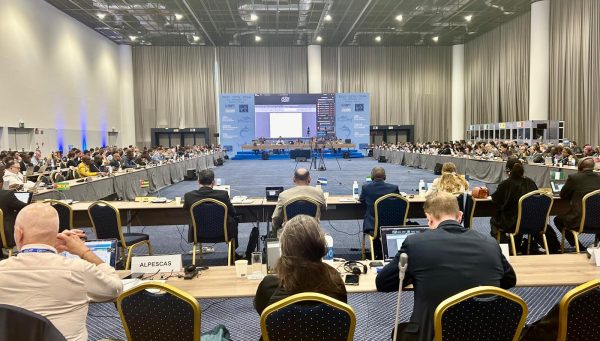
The International Commission for the Conservation of Atlantic Tunas (ICCAT) just wrapped up its annual meeting in Vilamoura, Portugal, the culmination of its 60th anniversary year. While they didn’t add another adopted management procedure (MP) to the roster, as they have in recent years, they did make progress on a number of key MP-related issues.
An exceptional circumstances protocol (ECP) was adopted for West Atlantic skipjack, which will be added as an annex to the MP adopted last year, completing the MP. Brazil’s proposal, cosponsored by South Africa, outlines the rare or unforeseen scenarios that could warrant reconsidering the application of the MP, as well as a decision tree to guide the deliberations on both the science and management sides.
These two southern countries also partnered to advance MP development for South Atlantic albacore, cosponsoring an MP framework proposal that guides ICCAT scientists on how to finalize the management strategy evaluation (MSE) process ahead of the scheduled MP adoption next year. We commend and congratulate South Africa and Brazil for their leadership to improve the management of ICCAT fisheries.
The Commission also agreed to some technical updates to the North Atlantic albacore MP, which was adopted in 2021 as an expansion of the harvest control rule adopted in 2017. The MP was run to increase the catch limit to 50,000 t, the maximum allowed under the MP. Since the HCR was adopted, the TAC has increased by 79% while the stock has grown by 61%, demonstrating the success of the MP approach.
Unfortunately, ICCAT did not agree to management objectives for the blue shark MSE, despite this being the second year for the European Union’s proposal and a clear request for guidance from ICCAT’s scientific body. The blockage? Another pelagic shark species: the shortfin mako. Another member wanted to add an objective related to makos since the two species have similar habitats and are thus caught in the same fisheries. Thankfully, the failed adoption should not impede the MSE, which can still progress to enable MP adoption by 2028 or 2029, in accordance with ICCAT’s MSE roadmap.
Despite 2 full days before the main meeting, and 4 additional sessions through today, ICCAT’s tropical tunas group, Panel 1, did not discuss the multi-stock MSE for bigeye, yellowfin, and eastern skipjack tunas. Instead, Panel 1 focused almost entirely on allocation of the yellowfin and bigeye catch limits. This was a missed opportunity to provide guidance on the MSE workplan and specifications, which was slated for completion this year for MP adoption in Vilamoura. However, continued scientific challenges and debates about how to handle multispecies interactions delayed the work. MP adoption is now scheduled for 2028, eight years behind the original deadline. Panel 1 will next meet in April 2027, with the MSE on the agenda. It will be imperative for managers to provide scientists with clear directions for the finalization of the MSE to avoid further delays. Those delays are costly, both due to the added year(s) of MSE funding and the unrealized benefits that having the MP in place would have afforded.
All in all, ICCAT made good progress on MPs this week, with three new measures adopted. The shortfalls for blue sharks and tropical tunas will not prevent the respective MSEs from proceeding, although both will require additional leadership from the scientists. 2027 will therefore be an important year for MPs at ICCAT, including MP adoption for South Atlantic albacore, the start of the Atlantic bluefin tuna MP review, and continued MSE progress for blue sharks and tropical tunas. With the additional groundwork laid this year, ICCAT has a clear opportunity to make tangible progress, and we look forward to working with members to keep MP development and implementation on track in 2027.
23 de noviembre de 2026

9 de noviembre de 2026

5 de octubre de 2026