31 de agosto de 2026
Rebecca Scott,
Program Officer, The Ocean Foundation

Credit: Kurt Arrigo / Ocean Image Bank
The environmental impacts of global climate change influence marine ecosystems in multiple ways, including changes in productivity, abundance, and spatial distribution of species. These changes have important implications for fisheries and are expected to become more pronounced with time as greenhouse gas emissions continue to rise. Multiple fishery management entities, including tuna Regional Fisheries Management Organizations (tRFMOs), have formal commitments in place to consider climate change impacts on stocks under their purview, including resolutions at the Western and Central Pacific Fisheries Commission (WCPFC), the Inter-American Tropical Tuna Commission (IATTC), the Indian Ocean Tuna Commission (IOTC), and the International Commission for the Conservation of Atlantic Tunas (ICCAT).
However, a challenge when developing climate-informed fisheries management policies is the uncertainty around long-term climate forecasts. Even if we understand the functional relationship between an environmental factor (e.g., sea surface temperature, SST) and biological process (e.g., recruitment), we cannot predict with certainty the degree to which environmental conditions will change over time. This makes it difficult to predict with confidence how fish stocks will respond to climate change, which in turn has made the adoption of management policies that consider climate change difficult. Fortunately, fisheries managers do not need to predict the future perfectly to be prepared for it.
Management strategy evaluation (MSE) is a framework already in use across fishery management bodies that allows for the testing of candidate management procedures (MPs), also known as harvest strategies, across a range of uncertainties and possible future conditions. This makes MSE an ideal tool for developing and testing MPs that support sustainable fishing practices despite system uncertainties, such as the ecosystem impacts of climate change. This is where the Climate Test, a new tool by the creators of the openMSE framework, comes in.
Rather than trying to exactly predict future climate conditions, the Climate Test simulation tests and rates the performance of candidate MPs under a range of increasingly severe climate scenarios. The analogy often used is that of testing pilots in a flight simulator; we cannot know with certainty what weather a pilot will encounter during a flight, but if all pilots (i.e., MPs) perform similarly well under normal flight conditions, why wouldn’t you select the pilot that can still safely fly the plane (i.e., manage the fishery) under more extreme weather conditions? In the same way, Climate Test puts candidate MPs through simulated future conditions and assesses their ability to meet management objectives as climate impacts intensify. The Climate Test can be easily added on to any MSE framework built in openMSE, providing a streamlined way for managers to evaluate the climate robustness of candidate MPs.
The Climate Test is being developed through several stages. The first involves exploratory tests, where MPs are rated for their climate robustness based on the assumed directional change of a handful of key biological parameters (decreased growth, increased natural mortality, decreased recruitment strength, decreased condition) under increasing climate change impacts. MP performance is assessed using a predefined robustness threshold, for example maintaining the stock size at or above 80% of the current spawning stock biomass (SSB) over the next 30 years. Candidate MPs are ranked by their climate robustness based on the magnitude of climate-related changes in stock dynamics they can withstand before the stock falls below the robustness threshold. For example, if candidate MP #1 (‘MP1’) maintains the stock above the robustness threshold under a 20% increase in natural mortality, but MP #2 (‘MP2’) can only maintain the stock above the robustness threshold under a 10% increase in natural mortality, then MP1 would be considered as more climate-robust. The exploratory Climate Test has been demonstrated for two stocks managed by ICCAT for which MSE-tested MPs are already in place: western skipjack and North Atlantic swordfish. Encouragingly, when the exploratory test was applied to the candidate MPs that had been considered for adoption for each stock, the Climate Test found that the MPs selected for adoption were the most climate-robust of the candidates evaluated.
The second stage of the Climate Test moves from assumed changes in individual biological processes toward conceptual climate tests, which use a hypothetical ecosystem model to simulate the combined impacts of climate change on multiple biological processes over time. For example, rather than simply testing a percentage decline in recruitment, the conceptual test can evaluate how MPs perform under increasing ocean warming scenarios (Figure 1). Returning to our example from above, a conceptual test could show that MP1 maintains the stock above the robustness threshold under a 0.9⁰C increase in SST, while MP2 can only maintain the stock above the robustness threshold under a 0.59⁰C increase in SST.
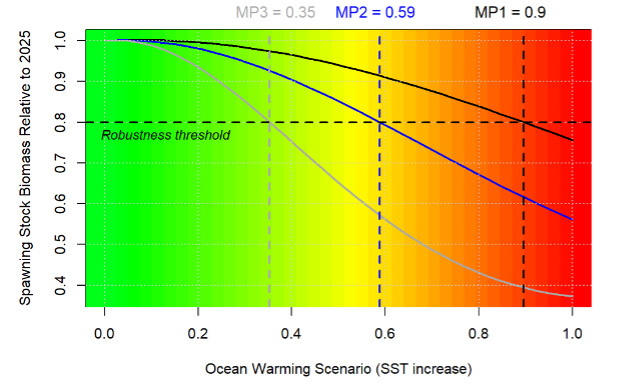
Figure 1. A demonstration of the conceptual Climate Test framework, which considers the combined impacts of climate change on multiple key biological processes and rates candidate MPs based on their ability to maintain the stock above a robustness threshold (in this case, ≥80% of current SSB) under different ocean warming scenarios. In this case, MP1 is the most climate-robust as it maintains the stock above the robustness threshold until an increase in sea surface temperature of 0.9⁰C. Source: https://climatetest.bluematterscience.com/
The next and final step in developing the Climate Test will be tailored tests using case studies from the Benguela upwelling system off the southwestern coast of Africa. In place of the hypothetical ecosystem model used in the conceptual tests, an Atlantis ecosystem model of the southern Benguela Current system will be used to simulate the biological responses of four case study stocks (anchovy, sardine, shallow- and deep-water hake) to a range of climate change scenarios. The Atlantis model will be informed by an earth system model under one historical and eight potential future carbon-emissions scenarios, or Shared Socioeconomic Pathways (SSPs), that span the full range of projected ocean warming. These responses from Atlantis will be incorporated into openMSE models to test hypothetical MPs for these stocks and evaluate which MP formulations perform the best for these life histories under increasing climate change impacts. The lessons learned can be applied in MSE efforts for stocks with similar life histories around the world, or new tailored tests can be developed for specific regions or stocks.
Integrating the Climate Test into future MSE efforts offers a path forward for fisheries management bodies such as the tRFMOs looking to fulfill their climate commitments. By moving past the need for perfect climate projections, the Climate Test equips managers with a structured decision-making tool that ensures MPs are robust to future environmental uncertainty. For more information, visit the Climate Test project page.

9 de septiembre de 2026