21 de mayo de 2026
Emmanuel Kwame Dovlo, Shingo Ota, Qayiso Kenneth Mketsu, Amar Ouchelli
ICCAT Panel Chairs

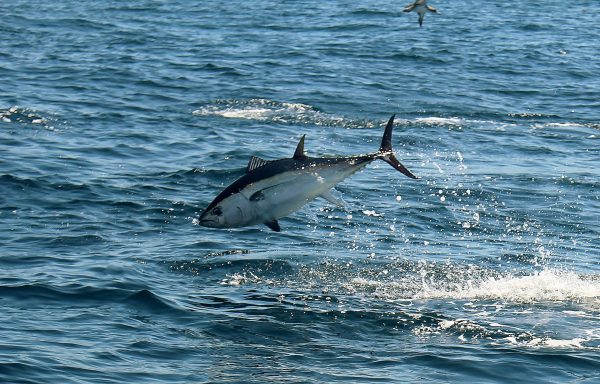
Photo by Willy Goldsmith | Flickr. CC BY-ND 2.0.
This piece is part of a series spotlighting leaders at ICCAT and the progress toward sustainable fisheries in the Atlantic.
2026 marks the 60th anniversary of the International Commission for the Conservation of Atlantic Tunas (ICCAT). Now with 55 contracting parties, ICCAT is divided into 4 panels responsible for managing tunas, swordfish, sharks, and other species across the entire Atlantic Ocean. Each panel has a chair who is formally elected by the Commission to lead discussions on management of their respective stocks. In celebration of ICCAT’s 60th anniversary, this article highlights reflections from all current panel chairs, focusing on major achievements and the trajectory of management strategy evaluation (MSE) and management procedures (MPs).
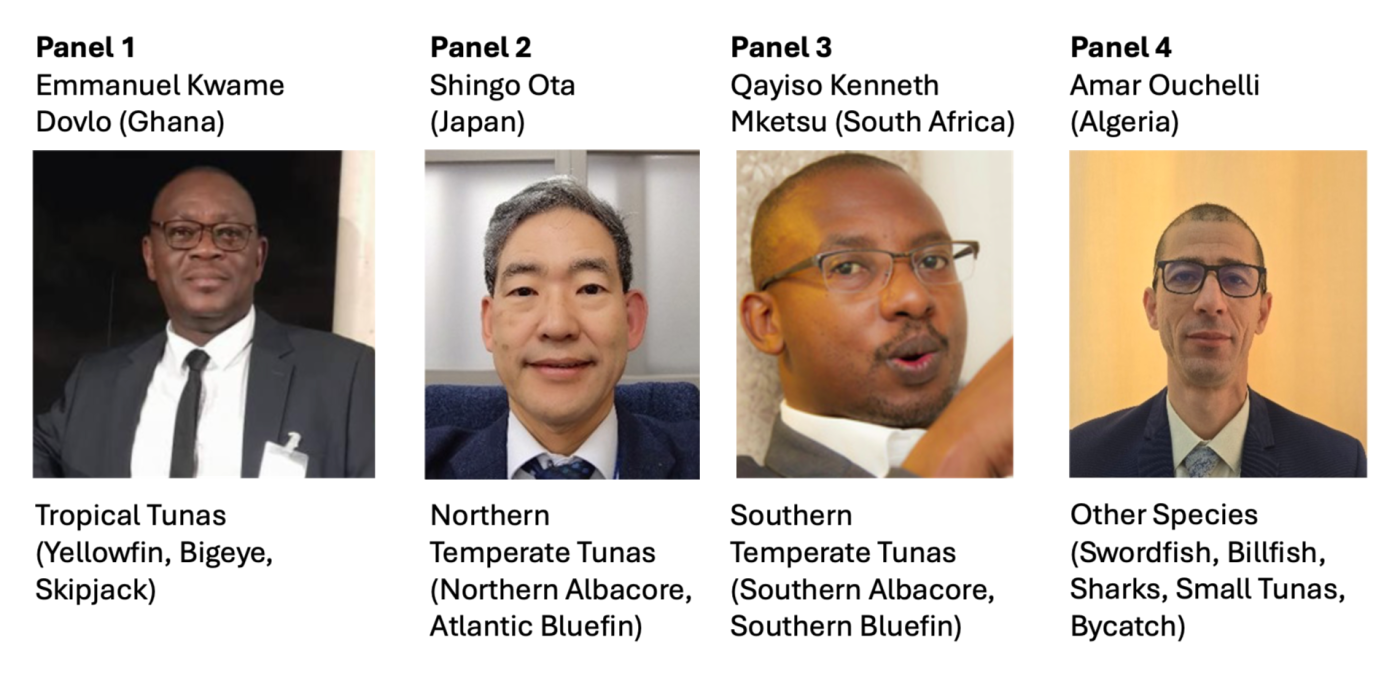
Dovlo – In 2023, I inherited chairmanship of Panel 1 amidst challenging negotiations on the multi-annual conservation and management programme for tropical tunas. I worked with almost all ICCAT members to conclude 5 years of intense discussions for a new measure to finally be adopted in 2024. An agreement was reached for a new total allowable catch (TAC) of 73,011 t for bigeye tuna, with a new catch limit allocation table that reserved 6,100 t for the small harvesters, while the TAC for yellowfin tuna remains at 110,000 t. This process demonstrated high-level collaboration to converge science-based management and balance individual member interests. In the same year, two important milestones in the development of tropical tunas MSEs were recorded – interim operational management objectives for Atlantic bigeye tuna, yellowfin tuna, and the eastern stock of skipjack tuna, and candidate MPs (CMPs) for Western Atlantic skipjack tuna. In 2025, the first ever tropical tunas MSE was adopted – Recommendation by ICCAT on a management procedure for Western Atlantic skipjack tuna.
Ota – I have been the Panel 2 Chair since 2017. There is no doubt that the most successful event during my tenure is the establishment of an MP for Atlantic bluefin tuna in 2022. For a long time, this species had been managed on a stock basis, namely the eastern stock and the western stock. The Commission set a TAC for the eastern stock at a level higher than the scientific recommendation of the Standing Committee on Research and Statistics (SCRS) before 2010. Even after that, the Commission spent much time deciding on the TAC for both stocks because the scientific recommendation was not clear due to data deficiency. To overcome scientific uncertainties and avoid political intervention, the Commission decided to establish an MP since it automatically calculates TAC levels, giving due consideration to scientific uncertainties. It was not easy for managers and stakeholders, particularly fishermen, to understand what was going on in the MSE that produced the MP. Managers and stakeholders tend to look at the possible immediate TAC level while scientists want to look at the performance of an MP for the longer term. Nonetheless, scientists, managers, and stakeholders worked very hard and were able to narrow down the number of candidate MPs from nine to two but could not pick one of them. Finally, on the evening before the last day of the 2022 annual meeting, the Commission agreed to one of them, which would be used to set the TAC for 3-year management cycles. That same day, the Commission also adopted an annual TAC for the first management cycle based on the adopted MP (i.e., 2023-25). The Commission also agreed to allocations among Members.
Mketsu – During my tenure as Chair of Panel 3, one of the key successes has been maintaining a stable and well-managed stock for South Atlantic albacore. The stock has consistently remained in the green quadrant of the Kobe plot, indicating that it is not overfished and that overfishing is not occurring, reflecting sustained collective management efforts by Contracting Parties and Cooperating non-Contracting Parties, Entities, and Fishing Entities (CPCs). In addition, an important recent milestone was the agreement in 2024 on initial operational management objectives for this stock, alongside a structured roadmap toward the development and adoption of an MP in 2027. This represents a significant step in transitioning from traditional management approaches toward more forward-looking, MSE-based frameworks.
Ouchelli – Over the past three years, in my capacity as Chair of Panel 4, we have worked collectively to strengthen conservation measures applicable to several species. The Commission has accordingly approved the measures proposed by Panel 4 prohibiting the retention of the whale shark, mobulid rays (Mobulidae), the basking shark, and the great white shark. Membership of Panel 4 has expanded to now include 44 Contracting Parties, and among the notable achievements is the 2024 MP adoption for North Atlantic swordfish, which established the TAC for the years 2025–2027. This follows extensive work by the scientific working group, as well as close collaboration among all Contracting Parties and stakeholders.
Dovlo – The first ever tropical tuna multi-stock MSE – which aims to evaluate robust MPs within a mixed-fishery context – was initially slated for completion and MP adoption this year. However, at the 2026 Intersessional Meeting of the Tropical Tunas Species Group (20-22 April), the group recommended updating Operating Models (OMs) to the 2025 Atlantic bigeye tuna stock assessment to reflect recent fishery trends and revised assumptions about natural mortality and uncertainty. A 2027 MP adoption has since been proposed to modify OMs and test CMPs in single-stock MSEs before progressing to multi-stock MSEs. That said, there is still work for the panel to do this year on this MSE as it will be important for Panel 1 to review and provide feedback on the initial CMP structure and results at the next meeting in November. With last year’s adoption of the MP for Western Atlantic skipjack tuna, work has also started on the stock’s exceptional circumstances protocol.
Ota – During the 2025 SCRS meeting, scientists could not agree on how to handle data from an Atlantic bluefin genetic analysis known as close-kin mark recapture (CKMR), which indicated that the western stock was much larger than previously considered. More specifically, scientists could not agree on whether the availability of such new data and the calculated size of the western stock would justify an exceptional circumstance (i.e., an unforeseen event or condition that falls outside the range of possibilities tested in the MSE). As a result, the SCRS provided two sets of TACs to the Commission. Further, some Members advocated that their fishermen were seeing a large number of fish in recent years, which corresponded to the results of the CKMR analysis. The Commission agreed to a TAC for the west area that is not necessarily in line with the MP but confirmed that the MP will be applied strictly at the 2028 annual meeting. In the meantime, work has begun on the bluefin tuna MSE health check and MP review, per the schedule agreed in the adopted MP.
Mketsu – The current focus is on advancing the technical development of the MSE for South Atlantic albacore. This includes further refinement of OMs, continued testing of CMPs, and incorporation of key sources of uncertainty identified by the SCRS. A dedicated MSE Technical Team has been established, and initial work has already been undertaken, including conditioning OMs on the 2020 stock assessment and exploring uncertainty through multiple scenarios. Upcoming work includes data preparation, refinement of CMPs, and continued interaction between the SCRS and Panel 3 to ensure that performance indicators align with agreed objectives. I look forward to reviewing the initial MSE results within Panel 3 at the 2026 Commission meeting.
Ouchelli – This year, per the MP adopted for North Atlantic swordfish, Panel 4 will assess exceptional circumstances. It should be emphasized that the adoption of this MP has paved the way for the MSE approach for blue shark (Prionace glauca), which is currently ongoing. Furthermore, stock assessments for Mediterranean and South Atlantic swordfish are being conducted this year, which may serve as a basis for future MSE-related work.
Dovlo – With the support of all Panel 1 members, I expect to see some preliminary results for the tropical tunas multi-stock MSE CMPs this year, along with a thorough roadmap for feedback and fine tuning for adoption in 2027. Also noteworthy is the exceptional circumstances protocol for Western Atlantic skipjack tuna incorporating climate change scenarios for adoption in 2026.
Ota – Based on the work plan for bluefin tuna agreed to in 2022, the Commission will start checking the stock status in 2026 and reviewing the current MP in 2027, which may end up with amendments to the MP or establishment of a new MP in 2028. For this purpose, several intersessional meetings involving scientists, managers, and stakeholders may be needed again in 2026 and 2027. This is also different from the initial expectation that once an MP is established, not so much time and energy will be required to maintain it. People are beginning to understand that an MSE and maintenance of an MP can sometimes be cumbersome rather than saving time, but there is no option to go back to the old era when Members had different interpretations on scientific advice and spent so much time agreeing to TACs. Brushing up on the MP would be the only way forward.
Mketsu – Given the significant progress made to date, there is a growing sense that this South Atlantic albacore work may advance more rapidly than initially anticipated. Subject to continued technical and policy alignment, it would not be unreasonable to envisage the Panel being in a position to consider adoption of an MP earlier than planned, potentially as early as the coming year. The agreed roadmap provides a clear pathway toward adoption of an MP, currently envisaged by 2027. In the near term, efforts will focus on finalizing the MSE framework, refining CMPs, and evaluating their performance against agreed objectives.
Over the medium term, the process will move toward narrowing down CMPs and supporting decision-making within Panel 3, with the aim of adopting an MP at the Commission level. Beyond this, attention will shift to implementation aspects, including the development of protocols for exceptional circumstances and ongoing evaluation of performance.
Overall, if momentum is maintained, this process has the potential to further strengthen the long-term stability and predictability of management for South Atlantic albacore within ICCAT.
Ouchelli – I expect to see gradual expansion of current management measures to other shark species and the integration of climate change impacts into our overall approach. There has been particular interest in climate change testing for MPs developed through MSE. Members are working diligently to strengthen data collection of sharks and other bycatch species which will help inform the Panel 4 recommendations to the Commission.
Plans are in the works for a more defined, thorough consultative process that promotes inclusive fisheries management. This may be especially relevant within the framework of establishing recovery programs for white marlin and roundscale spearfish. This approach takes into account the specific circumstances of CPCs that are Small Island Developing States, operating within a complex scientific and social context.
5 de octubre de 2026

22 de septiembre de 2026
9 de septiembre de 2026