27 mai 2026
Rebecca Scott
Program Officer, The Ocean Foundation

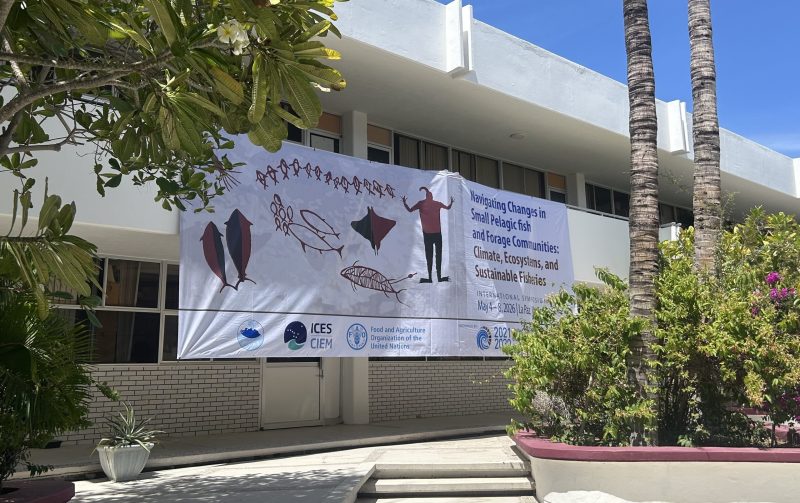
Earlier this month, Ash Wilson (The Pew Charitable Trusts) and I co-convened a workshop titled ‘Operationalizing Ecosystem-Based Management of Forage Species using Management Strategy Evaluation.’ The workshop was part of the program at the Small Pelagic Fish International Symposium hosted by ICES, PICES, and FAO in La Paz, Mexico. Held on May 4, 2026, the half-day workshop brought together 25 participants working in management strategy evaluation (MSE), ecosystem-based fisheries management (EBFM), and the intersection between the two. Through expert presentations and breakout discussions, workshop attendees explored how MSE-tested management procedures, also known as harvest strategies, can help advance ecosystem-based management approaches for forage fisheries under increasing environmental uncertainty.
Why MSE for forage species?
Forage species (e.g., sardine, anchovy, herring) play a critical role in the marine food web, linking low and high trophic levels by providing a key prey resource for predators such as marine mammals, seabirds, and large commercially important fishes (e.g., tunas, billfishes). However, their abundance in space and time is highly dependent on changing environmental conditions. Effective management of these species therefore poses a challenge, as patterns in their recruitment and biomass are driven by multiple interacting ecosystem and environmental factors, the individual impacts of which can be difficult to tease apart and simulate. Additionally, perceived relationships between the environment and forage fish population dynamics often break down over time, leading to high uncertainty in estimating recruitment and natural mortality using traditional stock assessment methods.
MSE is an ideal tool for addressing these management challenges for forage species, as MSE frameworks can be built to capture a wide range of possible ecosystem conditions and uncertainties, allowing managers to identify management procedures that remain robust under changing environmental and ecosystem conditions.
Showcasing emerging tools and real-world applications
In six presentations delivered by experts in the field, the workshop showcased existing research initiatives, case studies, and emerging tools designed to incorporate ecosystem considerations into fisheries management through MSE.
Three case study presentations highlighted regional examples of ecosystem considerations in MSE.
Regional discussions reveal shared challenges
Following the presentations, participants broke into regional discussion groups, where they discussed region- and stock-specific considerations for operationalizing EBFM, including identifying key drivers of variability, potential ecosystem indicators, critical data needs (including for building MSE frameworks), and the remaining hurdles to bridge science and management. Example fisheries discussed included Pacific sardine in the California Current, Gulf of Mexico menhaden, Bay of Biscay anchovy, Iberian sardine, and North Sea and Central Baltic herring. Across stocks, workshop participants repeatedly identified the need for a better mechanistic understanding of links between environmental variability and fish population dynamics in order to successfully incorporate ecosystem considerations into management. Similar ecosystem drivers, including upwelling and predation mortality, were identified across systems. At the same time, possible or existing approaches for incorporating ecosystem information into management (including MSE frameworks) varied among regions and species, reflecting differences in available data, ecosystem dynamics, and institutional contexts.
Looking ahead
A summary of the workshop, including a synthesis of breakout group findings on common challenges, shared ecosystem drivers, feasible indicators for MSE frameworks, and opportunities for collaboration across regions and forage stocks, was published in the July 2026 edition of PICES Press. A summary of this workshop can be found on page 55.
Additionally, key takeaways from presentations and discussions will be incorporated into a joint paper with other Symposium convenors and attendees, to be submitted to a special issue of a peer-reviewed journal.
Overall, the workshop highlighted the growing momentum and available tools for using MSE to operationalize ecosystem-based fisheries management for forage species and other stocks. As climate change and increasing environmental variability continue to impact ecosystems and fishery dynamics, implementing ecosystem-informed management approaches including MSE will become even more important for supporting sustainable fisheries.

5 octobre 2026

22 septembre 2026

9 septembre 2026